

Choosing the right loader for your construction operation isn’t just about horsepower or bucket capacity. It’s about matching the machine to your terrain, tasks, and budget. Compact track loaders (CTLs) and skid steer loaders (SSLs) may look similar, but their design differences can significantly impact your jobsite’s productivity and profitability.
Whether it’s an SSL’s four wheels or a CTL’s rubber tracks, it’s important to choose the right equipment for your construction site. To help you make this choice, Thompson Tractor’s guide compares CTLs and SSLs for construction applications.
Key Takeaways
- CTLs’ tracks provide better traction and lower ground pressure on soft or uneven terrain, while skid steers’ tires offer agility on hard surfaces.
- CTLs are ideal for sensitive ground, landscaping, or muddy conditions due to their low ground pressure, which minimizes soil compaction and damage.
- SSLs excel in tight spaces and on hard, stable ground, offering superior maneuverability with a zero-turn radius.
- CTLs typically have radial lift arms that are best for digging, while SSLs usually have vertical lift arms that are suitable for stacking and loading trucks.
- The ideal machine for your construction project depends on terrain, desired ground preservation, workspace size, and budget, with attachments adding versatility to both machine types.
The Design Similarities and Differences Between Compact Track Loaders and Skid Steers Loaders
The choice between a CTL and an SSL comes down to a few fundamental design differences that impact performance, cost, and suitability for different construction environments.
Undercarriage
The most obvious difference is what sits between the machine and the ground. A skid steer loader runs on four pneumatic tires, which are durable and well-suited for hard surfaces like concrete slabs, gravel lots, and compacted dirt on a jobsite.
A compact track loader uses continuous rubber tracks wrapped around a series of wheels or rollers. This design allows the tracks to “float” over soft ground by distributing weight across a much larger surface area, providing better traction and stability in conditions where wheels would sink or slip.
Ground Pressure
Ground pressure, measured in pounds per square inch (psi), is critical in construction because it directly affects site integrity and minimizes damage. High ground pressure compacts soil, which can lead to issues such as increased runoff, difficulty with subsequent excavation, or damage to underground utilities. This is particularly concerning for construction sites, as excessive compaction can hinder proper drainage, affect foundation stability, and complicate landscape restoration.
A typical compact track loader exerts around 4-6 psi, whereas a skid steer can exert 35-45 psi. This difference in ground pressure means that an SSL will create much deeper ruts as it works across your jobsite, while a CTL is much less likely to cause lasting damage to sensitive ground or finished landscaping.
If you’re working on newly graded areas, landscaping projects, or any area where surface integrity matters, the lower psi of a track loader helps preserve the soil structure and prevents excessive disturbance. Using a CTL on construction sites with sensitive underground utilities, such as irrigation systems and gas lines, can help reduce accidental damage that could lead to costly repairs.
Maneuverability
Skid steers earn their name from the way they turn. They change direction by varying wheel speed on each side, creating a zero-turn radius. This turning ability means they can pivot within their own footprint, making them highly agile in tight spaces like urban jobsites, crowded building interiors, or confined demolition zones.
Compact track loaders use the same turning principle, but their tracks create more resistance during turns, making them less nimble in confined spaces. The trade-off is superior stability and traction on slopes and uneven terrain. A CTL can be especially beneficial for excavation or grading on sloped terrain. Its enhanced stability may reduce the risk of rollovers, worker injuries, or project delays.
Lifting Capabilities
Both loaders are available with two main lift arm designs — radial lift and vertical lift. Radial lift arms follow an arcing path as they rise. This design is best for digging, grading, and work at or below ground level, providing a strong breakout force for tasks like excavating drainage ditches. Because of the environments in which radial lift arms are often used, they’re more commonly used on CTLs.
Vertical lift arms rise more straight up, keeping the attachment closer to the machine throughout the lift cycle. This is ideal for stacking materials, loading trucks, and lifting pallets over obstacles, which is why they’re regularly used on SSLs.
The Best Uses of Skid Steer Loaders
Construction professionals have used premium skid steer loaders to efficiently complete various tasks on their jobsites for decades. They’re a cost-effective choice for operations with significant infrastructure like concrete pads, paved paths, or large construction areas where agility and speed matter more than traction on soft ground.
Skid steers can help clean up demolition debris in cramped indoor spaces, saving time on manual labor. They also speed up material distribution, significantly reducing material placement time.
Where to Use Skid Steers
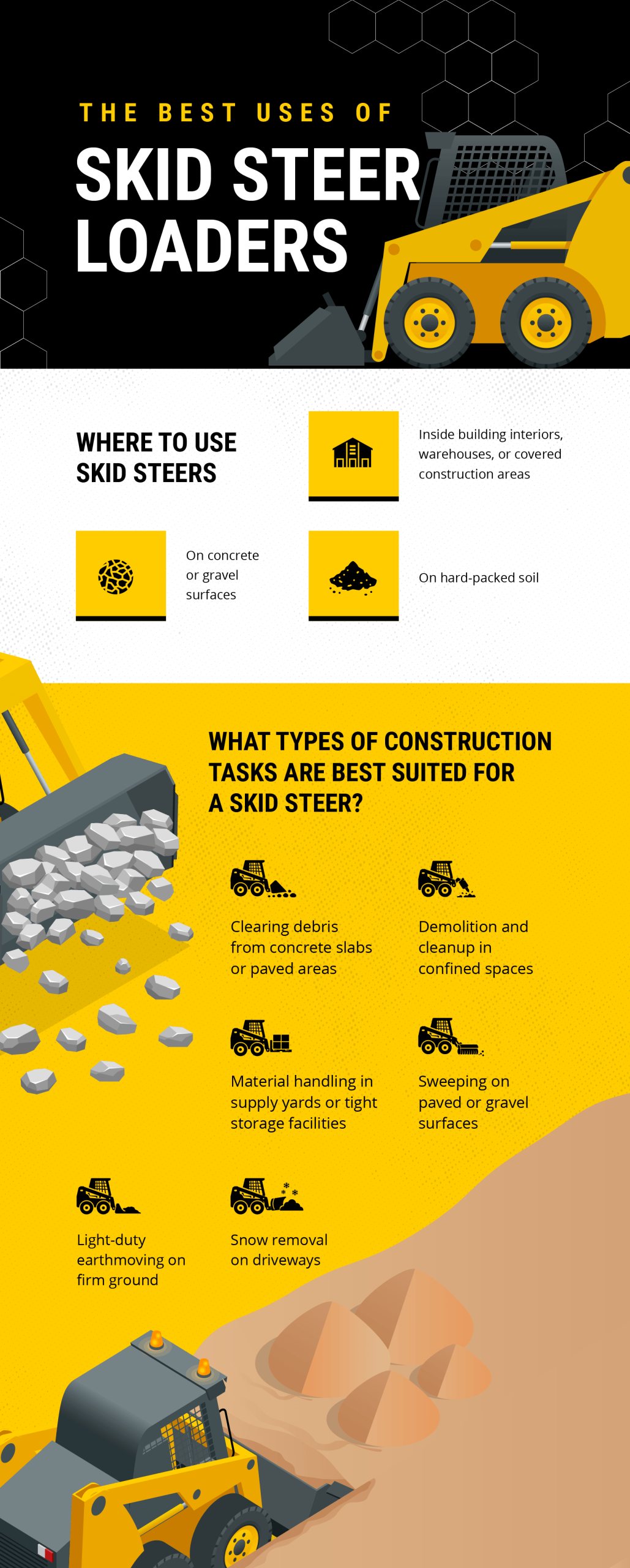
A skid steer is the logical choice in several construction environments, such as:
- Inside building interiors, warehouses, or covered construction areas: The zero-turn radius allows for maneuvering in tight spaces, making tasks in these areas faster with a skid steer’s agility.
- On concrete or gravel surfaces: Tires perform exceptionally well on hard, stable ground with no concern about track wear from abrasive surfaces.
- On hard-packed soil: A skid steer’s faster travel speed and responsive handling make it efficient for moving between jobsites on established paths.
What Types of Construction Tasks Are Best Suited for a Skid Steer?
Thanks to their design and the environments they can best operate in, skid steers excel at tasks where speed, maneuverability, and lower operating costs provide a clear advantage. Common applications include:
- Clearing debris from concrete slabs or paved areas
- Demolition and cleanup in confined spaces
- Material handling in supply yards or tight storage facilities
- Sweeping on paved or gravel surfaces
- Light-duty earthmoving on firm ground
- Snow removal on driveways
The Best Uses of Compact Track Loaders
If your construction project involves challenging terrain or sensitive areas, high-quality compact track loaders offer capabilities a skid steer can’t match. The investment pays off in versatility, the protection of your jobsite’s surface, and the ability to work year-round in conditions that would sideline wheeled equipment.
Where to Use Compact Track Loaders
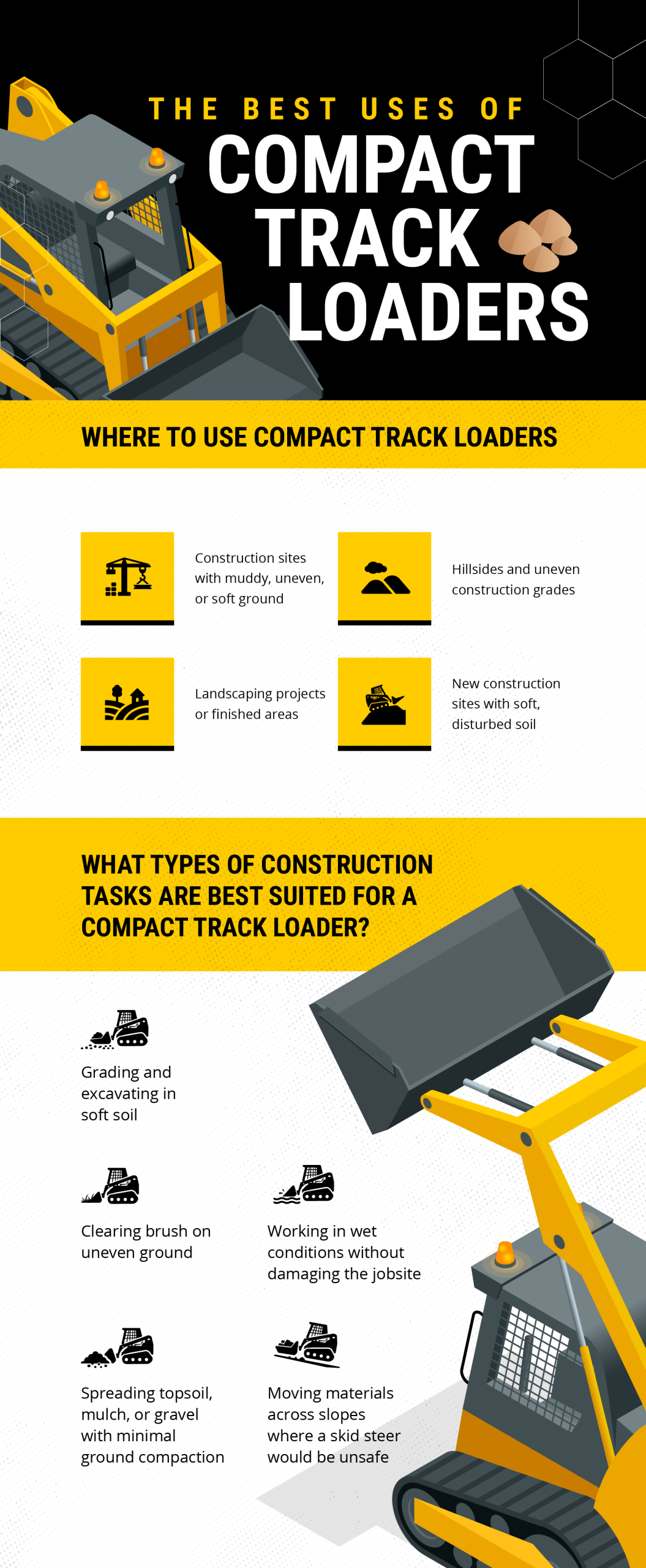
A compact track loader is the ideal solution in these environments:
- Construction sites with muddy, uneven, or soft ground: Tracks provide consistent traction in wet conditions, allowing you to keep working when a skid steer would get stuck.
- Landscaping projects or finished areas: Low ground pressure means you can grade and spread material across newly seeded medians, sports fields for public projects, or sod around commercial buildings without tearing up the surface.
- Hillsides and uneven construction grades: Superior stability and traction make CTLs safer on slopes where wheeled machines struggle.
- New construction sites with soft, disturbed soil: A CTL’s ability to navigate unfinished terrain keeps projects moving forward.
What Types of Construction Tasks Are Best Suited for a Compact Track Loader?
Compact track loaders shine where stability, traction, and minimal ground disturbance are essential:
- Grading and excavating in soft soil
- Clearing brush on uneven ground
- Working in wet conditions without damaging the jobsite
- Spreading topsoil, mulch, or gravel with minimal ground compaction
- Moving materials across slopes where a skid steer would be unsafe
Track loaders are also valuable for land improvement projects, site preparation, final grading around new construction, and working on sandy or loose fill during commercial development.
The Cost of Ownership
When choosing equipment, look beyond the sticker price to the total cost of ownership over the machine’s life.
Up-Front Costs
Compact track loaders typically cost more than a comparable skid steer. For a new machine, this can mean a difference of several thousand dollars.
To reduce the initial costs, many contractors buy used construction equipment, as this offers opportunities to reduce their up-front investment. A well-maintained used CTL might cost less than a new skid steer while still providing the traction and low ground pressure your project needs.
CTLs typically have higher up-front costs, but it’s important to consider the total project scope. For example, if a project involves soft groundwork, the CTL’s durability can make the initial costs worth it because it reduces rework and delays.
Long-Term Operating Costs
Fuel consumption is an unavoidable cost of both CTLs and SSLs. While each machine’s fuel consumption is generally comparable when working on similar terrain, efficiency varies by condition. For example, a skid steer may use less fuel on hard surfaces due to lower rolling resistance. On the other hand, a CTL maintains consistent efficiency even in mud where a skid steer would labor while fighting for traction.
Routine maintenance is necessary to keep your machines working well, but how regularly they need maintenance, and how much that maintenance costs, varies from one machine to the next. For CTLs and SSLs, maintenance costs differ primarily in the undercarriage. Skid steers require tire inspection, rotation, and air pressure checks, all of which are usually fast and inexpensive to perform. Track loaders need track tension adjustments, regular cleaning, and periodic inspection of rollers and drive motors, which can take much longer in comparison.
For projects with rough terrain, the CTL’s track longevity might save you on tire replacements. CTLs can also help reduce maintenance costs and downtime throughout the project’s life cycle.
Replacement Costs
Since skid steers and compact track loaders share many of the same parts, most of their replacement costs will be similar. However, the parts found in the undercarriage vary more widely, and they differentiate the replacement costs associated with both machines.
A set of skid steer tires might cost a few thousand dollars, while a CTL’s rubber tracks can cost significantly more, sometimes three to four times the price of a tire set. However, rubber tracks tend to last longer than skid steer tires, particularly on softer ground rather than abrasive surfaces. So, despite being more expensive, rubber tracks could be more cost-effective over time thanks to their longevity.
The Role of Attachments
The true power of both loaders is their ability to become a jack-of-all-trades through a wide range of attachments. This versatility makes them valuable on construction sites with diverse tasks.
Common Attachments for Construction
Most attachments are compatible with both machine types. Common options for construction work that can be attached to both SSLs and CTLs include:
- Standard, low-profile, and grapple buckets for transporting materials
- Pallet forks for moving building materials and pallets
- Grapples for land clearing and vegetation management
- Augers for fencing projects or post-hole digging for foundations
- Brush cutters and mulchers for site preparation
- Cold planers, trenchers, or hydraulic breakers for specialized construction tasks
The universal quick-attach system means you can swap attachments in seconds without tools, maximizing productivity throughout the workday.
Attachment Compatibility and Considerations
While most attachments work with both CTLs and skid steers, performance depends on matching the attachment to the machine’s hydraulic flow capabilities. Each attachment has minimum flow requirements measured in gallons per minute (GPM).
Before purchasing an attachment, verify that your loader’s hydraulic system can deliver the required flow and pressure. High-flow hydraulic systems significantly expand your attachment options and improve performance on demanding tools like brush cutters and mulchers.
Safety and Operator Comfort
Modern loaders prioritize safety and operator comfort, crucial for long workdays and jobsite efficiency. A comfortable, alert operator is a safe operator.
Key Safety Features to Look For
Both loaders should include fundamental safety features, such as a rollover protective structure (ROPS) and falling object protective structure (FOPS) cab, which protects the operator from crushing injuries.
Backup cameras and enhanced visibility features help prevent accidents when operating around other equipment, structures, and workers. Many machines also include proximity sensors that alert operators to nearby obstacles.
Additional features include operator presence systems that prevent movement unless the operator is properly seated, clearly marked controls, and adequate lighting for early morning or evening work. These features can be applied to both CTLs and SSLs.
Operator Comfort Features
When comparing the comfort of the two machines, compact track loaders generally provide a smoother ride than skid steers, especially on rough terrain. Tracks absorb bumps more effectively than tires, reducing the jarring motion that causes operator fatigue.
While comfort features can feel like nice-to-haves rather than necessities, an operator will tire more slowly when they’re comfortable. They can then remain more alert and make the right decisions, reducing the likelihood of mistakes.
One feature that helps operators work in comfort is climate control. Available on both CTLs and SSLs, heating and air conditioning allow operators to work efficiently in extreme temperatures, while sealed cabs reduce dust and noise exposure.
Adjustable seats with lumbar support, ergonomic controls, and low-vibration designs further reduce fatigue. While these features are also available on both CTLs and skid steers, the inherently smoother ride of a track loader amplifies their benefit.
Making the Right Choice for Your Construction Project
Choosing between a compact track loader and a skid steer isn’t always obvious. To determine the right machine for your needs, consider:
- How often you work on hard surfaces versus soft ground: If most tasks occur on concrete, gravel, or hard-packed soil, a skid steer makes sense. If you regularly work on muddy jobsites, soft ground, or uneven terrain, a CTL’s traction and low ground pressure justify the investment.
- The importance of site preservation and minimizing ground disturbance: For landscaping, excavation, or infrastructure projects, preventing excessive ground disturbance directly affects your bottom line.
- The terrain challenges you face: Steep slopes and wet conditions favor a compact track loader’s stability, while a skid steer works fine for flat, stable terrain.
- Your budget for initial purchase and long-term maintenance: Skid steers cost less up front and are simpler to maintain, but tracks can last longer under the right conditions.
- The size of your working spaces: If you’re constantly maneuvering in tight urban construction zones or interior demolition areas, a skid steer’s zero-turn radius provides a real advantage.
Balance each of these considerations to find the machine that’s best suited to your construction operations.
Optimizing Construction Work With CTLs and Skid Steers
Determining which loader is right for your construction project comes down to understanding your site’s unique demands and how well each loader can meet them. From managing timelines to maximizing equipment ROI on urban jobsites, you need to consider how your loader will meet your needs in each of these areas.
Whichever machine you choose, working with a reputable dealer who understands construction applications ensures access to parts, service, and expertise that keep your project running efficiently.

Sign Up For Our Emails
Get the latest product updates and monthly specials